
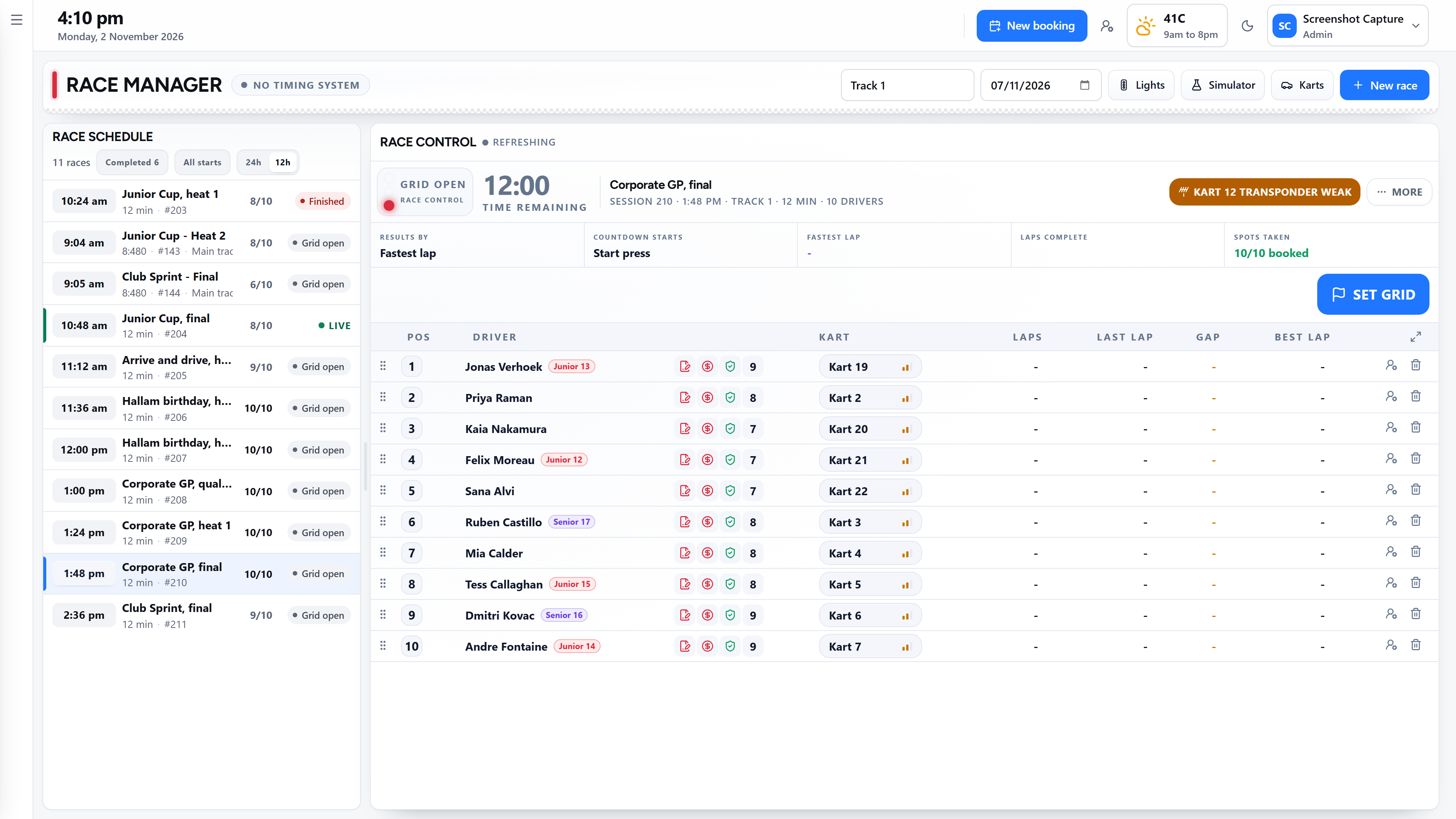
Kart track race control software.The grid is checked before it is armed.
Waivers, payments, karts and transponders are verified in one pass, so what a marshal would have found on the dummy grid is on the screen instead. A manager can send it anyway with a PIN, and the reason they gave is kept against the race.
During the race
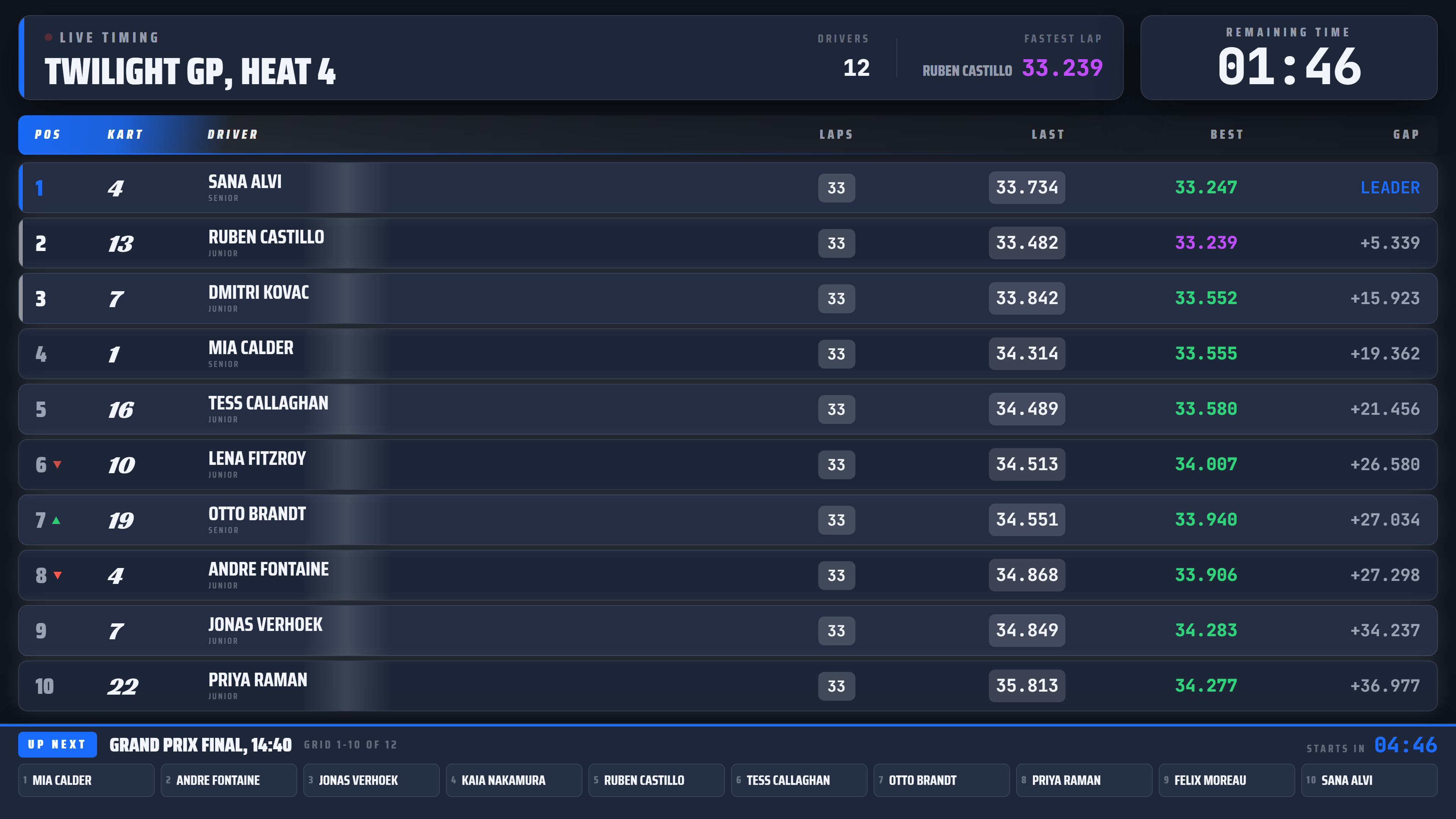
A board that reads from across the room.
Positions move as the crossings land and the fastest lap of the session lifts out of the list. Venubridge writes every lap to the venue machine first and pushes it up afterwards, so a dropped line costs you a sync and never a lap.
- Positions reorder in place as the decoder reports
- The session's fastest lap picked out while it still stands
- One flag change driving the tower and kart speed together
- Laps on disk before anything is sent anywhere
After the flag
The result is out before the helmets are off.
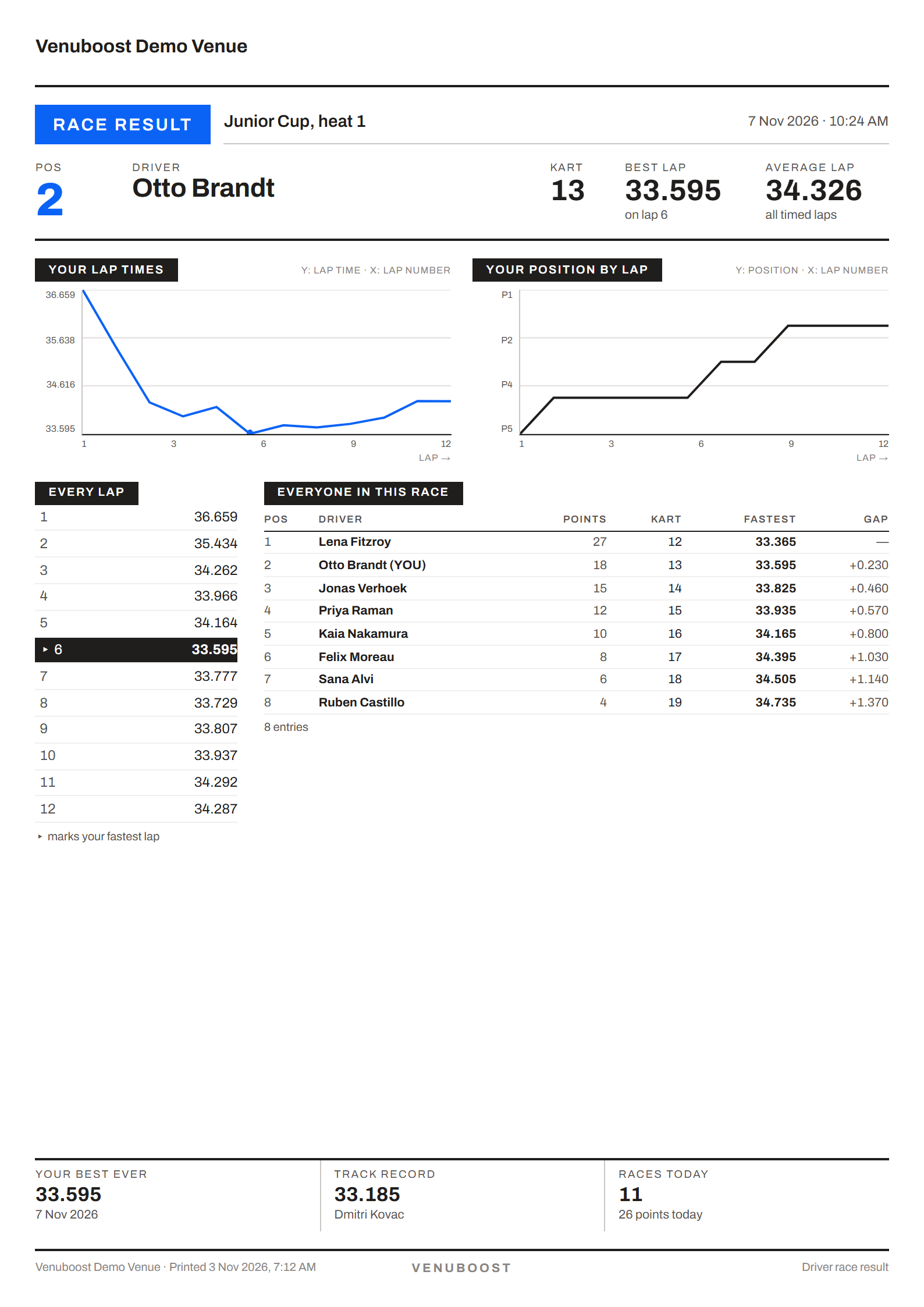
The classification prints at the counter as the drivers walk in, and the same result goes up on the wall as a full page slide. That slide is the thing people photograph, so it carries your venue's name on it.
- Every lap the driver did, with their quickest one marked
- Their position lap by lap, so a drive through the field shows
- Their best ever here, the track record and the day's points
- Printing at the counter without anybody pressing print
- The same result on the wall, sized for a television
Race control is one part of Venuboost for kart tracks. The decoders, the timing boards, sector splits and fast times are on the live timing page.
The checks
Four things that ruin a heat, caught in advance.
Waiver missing
A seat with nobody signed against it comes up before the grid arms, named, so the counter can send a QR to the parent standing in front of them.
Seat unpaid
Anyone still owing shows against their kart number. The grid will not arm on an unpaid seat unless a manager signs it off.
Kart not ready
A kart with no transponder mapped to it, or one sitting in the workshop, cannot be handed to a driver by accident.
Driver in two places
The same person down for two heats in the same window is caught here, rather than by a marshal counting helmets on the dummy grid.
A hold stops the grid arming. A manager can send it anyway with a PIN, and what they gave as the reason stays on the race.
Beyond the heat
Leagues, points, and a fleet that gets looked after.
Points and series
Points per stage, rolled into a series, with standings that move as each heat finishes rather than when somebody gets round to updating a spreadsheet.
Stages and formats
Qualifying, heat, final. Each stage keeps its own run time, lead in and scoring, so a format is built once and then booked all season.
Kart fleet
Which transponder is in which kart, the hours on each one, and what is in for service. A kart in the workshop drops out of the pool until it comes back.
Experiences
One driver, or a field of thirty, and nobody picks up the phone.
An experience is built once, out of stages, and then the day is worked out from whoever books it. A walk in takes the next heat. Thirty for a corporate becomes three groups taking turns. Both come out of the same experience, and neither needs a member of staff to lay it out by hand.
This is the part most systems give up on. A two race event is easy to sell when the track is empty and impossible to sell by half past one on a Saturday, so most venues take the booking on the phone and build the day in their head. Here the gap between a group's races is a range, not a number, and the booking engine solves it against the day as it already stands.
- Qualifying, heats and a final, each with its own run time, lead in and scoring
- Grid order as booked, reversed, drawn at random, or built from the session they just ran
- An experience can hold the track to itself, and stay private when the group is split
- Split a large group across two tracks, and merge the legs back if a driver drops out
- A format built once and then booked all season
A gap with room in it
Every stage carries three numbers: the shortest gap you will accept before it, the longest, and the one you would rather have. Booking aims for the one you would rather have, and only moves off it when the day leaves no room, in which case it takes the shortest gap that fits before it tries a longer one.
Gaps measured in races as well as minutes
A gap can be written as two sessions rather than twenty four minutes. Their second race lands two heats later and the heats in between are still yours to sell. The awkward slots in the middle of a two race booking stop being dead time and start being walk ins.
A different gap for a bigger party
The rule can change with the size of the booking: one set of gaps for a party that runs as one group, another for a party split in two, another again for three. A corporate of thirty does not get the rhythm you wrote for a family of six.
Ten karts on the grid does not mean ten people can book.
A track capacity is the number of karts that go out at once, and it is the one thing every booking page treats as the size of the party it can take. Twenty four people look at a ten kart track and are told no, so they ring up, and somebody at the counter spends ten minutes working out three groups on a piece of paper.
Set a minimum and a maximum on the experience and the number in between is anything at all. Twenty four becomes three groups of eight, each group gets every stage the experience holds, the gaps between their turns stay inside the rules you set, and the whole itinerary is laid out before they have paid. On a quiet morning it uses the gap you prefer. On a full Saturday it tightens to the shortest one that still fits, and if no running order can hold every rule that start time is not offered at all rather than offered and then apologised for.
The guest sees
One arrival time, their own running order, and what time they are finished.
The track sees
Three groups placed where they fit, with the slots between them still open.
Nobody sees
A phone call, a spreadsheet, or a member of staff rebuilding the afternoon.
Your tracks
Add a second track without adding a second system.
Every space in the centre is its own row in settings with its own numbers on it. Two tracks, an outdoor circuit and an indoor one, a junior track that runs shorter heats, an arena and a row of lanes beside them. They all sit on the one board and run at the same time without fighting over the same schedule.
Its own capacity
Ten karts on one track and eight on the other is simply two numbers. Nothing can be sold onto a track that does not have the karts for it.
Its own clock
Lead in, running time and turnaround are set per track, so a twelve minute heat on one and a twenty minute endurance run on the other both schedule correctly.
Its own start times
Each track has its own spacing and its own anchor, so one can run on the quarter hour and the other every twelve minutes from ten o'clock.
Its own lap length
The circuit length and the fastest believable lap are set per track, in metres or feet, so a split time is read against the right circuit and a double read is caught on the right one.
Its own breaks
A minimum, a maximum and a preferred gap between a group's turns, per track, so a group on the junior circuit is not held to the same rhythm as a corporate on the main one.
One app, one counter
The same till, the same board, the same race control. Staff do not learn a second system because there is only ever one, however many spaces you open.
A decoder is added per track as well, so a centre with a loop under each circuit runs both through the one bridge. A group too big for one track can be split across two and merged back if a driver drops out, which is a thing staff choose rather than a thing the schedule does to them.
Venubridge
Hybrid. The track runs on your own network, the business runs on the cloud.
A cloud system alone cannot run a race. A crossing has to become a lap, a position and a light change faster than a driver can reach the next corner, and the internet is not reliable enough to be in the middle of that. A local system alone cannot run a business either: you end up with a server in a cupboard, a backup nobody checks and no way to look at last Saturday from home.
Venubridge is one app on one always on computer at the centre, and it is the only machine that talks to your hardware. The things that cannot wait happen there, on your own network, in milliseconds. Everything else is in the cloud a second later.
On your network
Timing, the flag, the light towers, the pit board, the printers, the Venucast screens and the tills. None of it waits on a connection to us.
In the cloud
Bookings, customers, results, points, reporting and every other venue you run. Reachable from home, backed up by us, and never a machine you maintain.
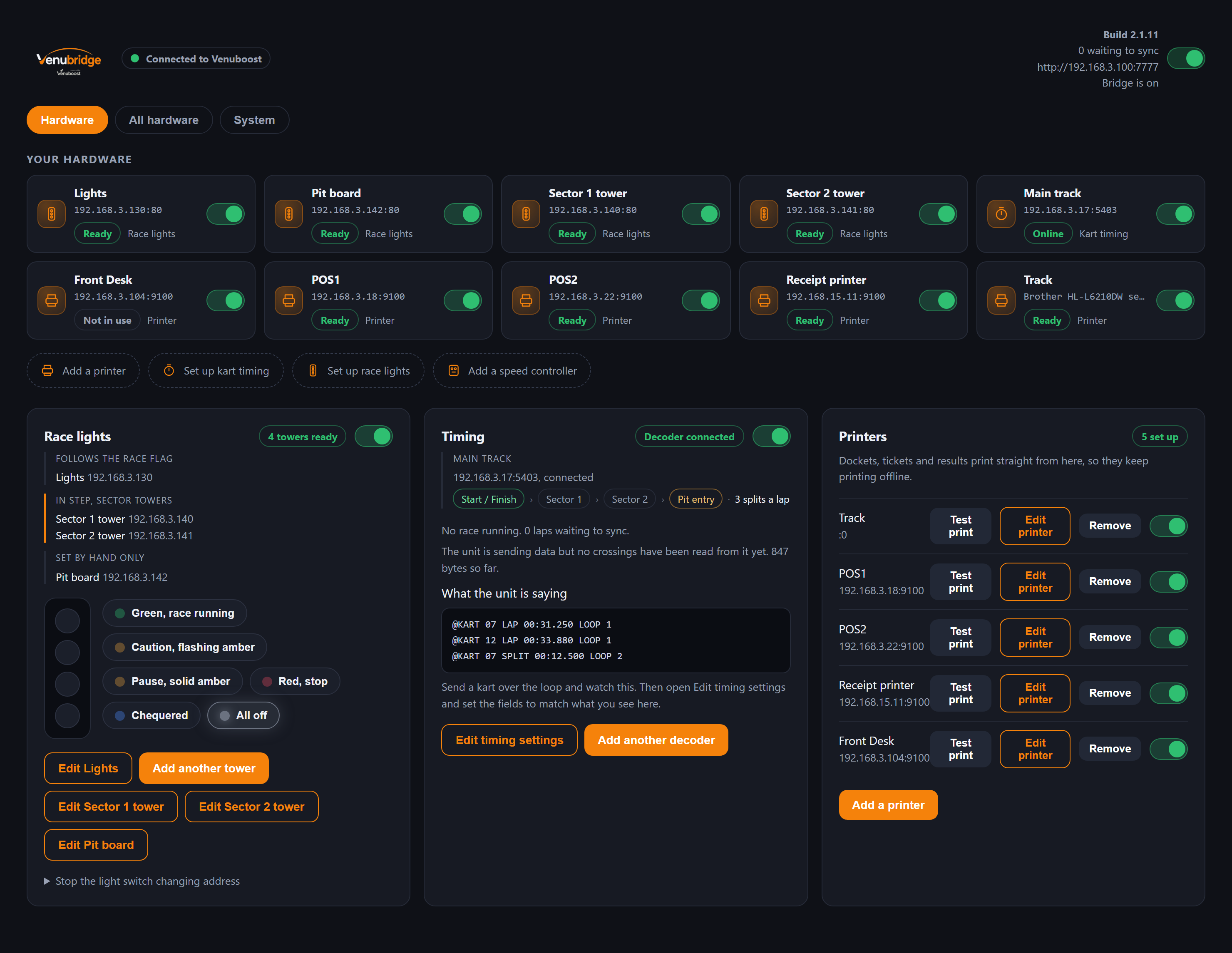
Laps are on disk before they are anywhere else.
The bridge keeps an append only log at the venue, flushed to disk before the call returns. A power cut can lose the line being written and nothing before it. Nothing native is used anywhere in it on purpose, so it installs on a locked down venue PC with no build tools and there is no database to corrupt and stop you trading.
Timing runs at the venue
A crossing becomes a lap, a position and a light change on the machine in the building, and keeps doing it with the line down. The race does not know or care whether we are reachable.
A second to the cloud
Laps go up every second. Each one carries a local id and the cloud holds a unique index on it, so a batch can be resent as often as a bad line needs and nothing lands twice.
A double read is not a lap
A crossing quicker than the venue's own minimum lap is a second read at the loop, not a flying lap, and is treated as one before it reaches a result.
The till keeps selling
Counter terminals fall back to the bridge over your own network when the internet goes, so sales, check ins and printing carry on and are replayed when the line returns.
Hardware that moves is found again
The bridge learns each device's factory hardware address while it works. If a router swap changes an address it looks for that same device and moves it only on a single certain match. It never guesses.
It looks after itself
New builds are fetched in the background and installed the next time the app closes. Every build is code signed and only ever comes from a Venuboost address.
Screens
A screen on your network is instant. A screen anywhere else still works.
A Venucast screen takes the short path first. The bridge holds the whole wall locally, the screens, the slides, the media and the live feed, and serves them over your own network, so a film is downloaded once, keyed by its checksum, and from then on it plays off the machine in the next room rather than off the internet.
When no bridge answers, the screen falls back to the cloud and carries on. That is what lets a screen live outside the building: a reception in the next unit, a window down the street, a television at somebody's house on a league night. Same wall, reached the long way round.
Screens on your own network check in with the bridge every half minute, and we only ever hear one small summary a minute for the whole centre, however many televisions you hang.
The driver briefing, from any screen
Assign the briefing film to the screens that should show it, and the transport appears in the top bar of Venuboost: play, pause, restart and stop, from whatever page the staff member happens to be on. No walking back to the office, and no remote to lose.
Pressed here, playing there
A press goes two ways at once, to the bridge across your network and to the cloud. Whichever arrives first starts the film and the other copy is dropped, because both carry the same mark. In practice it is milliseconds, and it still works with the internet down.
Only the screens you armed
Commands go to the screens the briefing was assigned to, by name. A wall showing the next races carries on showing the next races while the briefing room plays the film.
Getting started
Running races this afternoon, not next quarter.
There is no server to specify, no rack to build and nobody to fly in. The computer is an ordinary small desktop machine next to the counter, because all it is doing is talking to devices on your own network.
- 1Download and install itA one click installer on Windows, or a drag to Applications on a Mac. The Windows installer picks the language of the machine on its own.
- 2Type the pairing codeVenuboost gives you a code, the app takes it once, and the two are joined for good. Nothing needs opening at your edge: every connection it makes to us is outbound.
- 3Let it find your hardwareIt sweeps your network and asks every address what it is, so staff are choosing a device from a list rather than hunting for an IP address on the back of a printer.
- 4Run a raceA device added in Venuboost is live on the bridge within about five seconds. There is no deployment, no cutover weekend and no downtime to schedule.
The decoders you already run
MyLaps decoders on P3, such as ProChip and RC4, and RACE RESULT 4000 and 5000. An X2 installation reads through a converter in front of its X2 Server. DeHaardt controllers slow and stop the karts. There is a simulator too, for setting a centre up or training staff before a kart has turned a wheel. More on timing.
Lights, boards and speed control
Shelly relays in both generations, Tasmota, an LED flag panel, or anything else that answers a web address. One flag change drives the tower and kart speed together.
Printers at every counter
Receipt, label and results printers over the network, each attached to the counter it stands on. Dockets, tickets and classifications print from the bridge, so they keep printing when the line is down.
A brand we do not have yet
A new decoder is one file in the bridge and one line in a list. Nothing else in the product changes, which is why adding one is a conversation rather than a project.
The fleet and the tags
A flat transponder battery takes a fortnight to cost somebody a result.
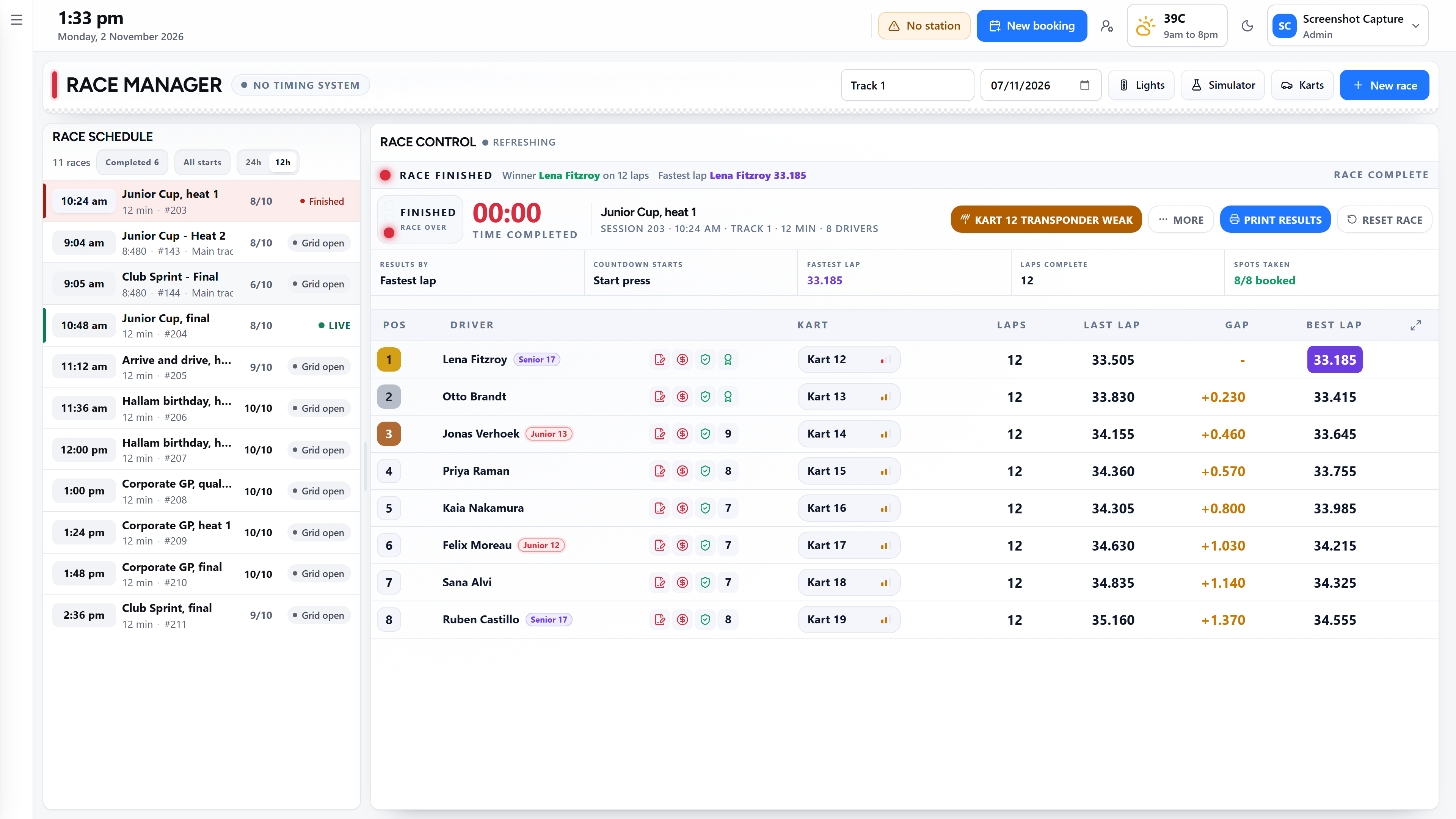
Every crossing carries two readings beside the time: how loud the tag was over the loop, and how many times the loop caught it. A tag going flat reads quieter and less often, week on week, long before it drops a lap. Race control folds that into one plain line rather than a wall of numbers.
Signal beside the kart
A bar on each row, and a named warning in the header when a tag is fading, so it is changed on a Tuesday rather than mid heat on a Saturday.
Hours on every kart
What each kart has run, so a service is due on use rather than on somebody's memory.
In the workshop
A kart marked out of service leaves the pool, and cannot be handed to a driver by accident.
Laps follow the kart
A mid race swap, or a driver taking a kart that was not theirs, still ends with the right laps against the right person.
Bring us your busiest Saturday and we will build it on the screen.
Half an hour, your own activities and your own prices on the board. You will see where the day has gaps in it before we say a word about what this costs.